

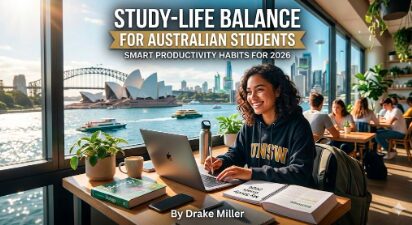
For many Australian students, the “University dream” or the final years of high school (HSC/VCE/QCE) can quickly transform into a high-stakes juggling act. In 2026, the pressure is higher than ever. Between attending lectures at USYD, Monash, or the University of Melbourne, clocking in shifts at a part-time job to combat the cost-of-living crisis, and trying to maintain a social life, students are hitting “burnout” before they even graduate.
Achieving a healthy study-life balance isn’t about working harder; it’s about working smarter. In the current Australian academic landscape—where the “P’s get degrees” mentality has been replaced by an ultra-competitive graduate market—productivity habits are your best defense.
As someone who has spent over a decade mentoring students through the stressors of the Australian Tertiary Admissions Rank (ATAR) and beyond, I’ve seen which habits stick and which lead to a mid-semester meltdown. Here is your 2026 guide to mastering your schedule.
1. Utilize Professional Support Early
Smart students know when to delegate or seek help. You don’t have to struggle with complex Harvard referencing, structural gaps, or overwhelming workloads alone. While university writing centers are excellent, they are often overbooked during peak assessment periods, leaving students in the lurch right before a deadline.
In my experience, high-achieving students maintain their edge by supplementing their learning with reliable academic resources. If you find yourself struggling to balance a heavy workload and need expert guidance to ensure your research meets Australian standards, you can seek online assignment services to help streamline your academic journey.
This allows you to focus on mastering core concepts while ensuring your written submissions are polished and professional.
2. Master the “Census Date” Mentality: Planning Backwards
In the Australian higher education system, the semester moves with a specific rhythm. One of the most effective habits I teach my students is “Backward Mapping.”
Instead of looking at what is due tomorrow, look at your unit outlines the moment they are released. Identify the “heavy hitters”—the 40-50% research essays or the high-scaling final exams.
The Strategy: If a major project is due in Week 10, your research phase should be finished by Week 7. This prevents the “all-nighter” culture that plagues many share-houses in Sydney and Melbourne. When you work backward, you aren’t just managing time; you’re managing stress.
3. The “Eat the Frog” Strategy
This habit involves tackling your most difficult or most dreaded task first thing in the morning. For a student, the “frog” is usually that 3,000-word essay or the complex statistics module you’ve been avoiding.
If you find quantitative units particularly daunting, getting specialized Math assignment help early in the week can prevent a backlog of difficult problems. When you finish your hardest task by 10:00 AM, the rest of your day feels significantly lighter.
4. Leverage the Power of “Deep Work”
The biggest productivity killer in 2026 isn’t a lack of time; it’s fragmented attention. With constant digital notifications, students are often in a state of “semi-distraction.”
Adopt the Pomodoro Technique with a specialized Aussie twist:
- 50 minutes of Deep Work: Total focus on one task (e.g., writing your thesis statement or solving a lab report).
- 10 minutes of “True” Rest: Step away from the screen. Walk outside, grab a flat white, or do a quick stretch. Do not scroll social media during your break—it keeps your brain in a “high-arousal” state and prevents genuine recovery.
5. The Ethical AI Frontier: Using Tools Responsibly
By 2026, most Australian universities have integrated strict AI policies. To rank high in your classes, you must use AI as a co-pilot, not an auto-pilot.
- Brainstorming: Use AI to generate essay outlines or explain a difficult Chemistry concept.
- Refining: Use it to check for tone or clarity. Always ensure the final output is your own voice. Over-reliance on AI stunts the very critical thinking skills that employers at firms like Deloitte or Atlassian are looking for.
6. Optimize Your Environment: The “Third Space”
A common productivity mistake is studying in the same place you sleep. Your brain associates your bed with rest, making it harder to focus. Find your Productivity Sanctuary.
Whether it’s the quiet floors of the State Library of Victoria, the Fisher Library at USYD, or a local quiet cafe, having a dedicated space for work tells your brain: “We are here to be productive.”
7. Prioritize Physical “Battery” Management
You cannot be productive if your “internal battery” is at 5%. Australian students often sacrifice sleep and nutrition during exam blocks, which lowers cognitive function.
- Sleep: Aim for 7–8 hours. This is non-negotiable for memory encoding.
- Movement: A 20-minute walk in the sun provides Vitamin D and a mental reset that no amount of caffeine can replicate.
- Meal Prep: Spend Sunday afternoon prepping healthy meals. It saves money and prevents the “sugar crash” from fast food.
8. Digital Minimalist Habits
Use “Focus Modes” on your devices to block distracting apps during study hours. I recommend tools like Forest; for every 25 minutes you stay off your phone, you grow a digital tree. It’s a small gamification tactic that has a massive impact on focus for both high school and university students.
9. The Art of Saying “No”
Part of the Aussie university experience is the vibrant social scene. However, saying “yes” to every event is a fast track to academic stress. Practice Selective Socializing. Choose the events that truly matter to you and politely decline the others.
Frequently Asked Questions
Q.1 How can Australian students manage a part-time job and full-time study?
The key is Time-Blocking. Treat your study hours like a paid shift. By scheduling your “Deep Work” blocks around your roster, you ensure that neither your income nor your GPA suffers. Communicate your exam dates to your employer at least four weeks in advance to avoid “Census Date” stress.
Q.2 What are the best productivity apps for Australian high school students in 2026?
For focus, Forest and Freedom are top-tier. For organization, Notion remains the gold standard for tracking HSC or VCE syllabuses. For those needing specific academic guidance, platforms Myassignmenthelp.services provides tailored support for complex research tasks.
Q.3 How do I avoid burnout during the final exam block?
Prioritise Active Recall over passive reading. Testing yourself for 40 minutes is more effective than highlighting for 4 hours. Additionally, ensure you are getting at least 7 hours of sleep; the brain cannot process new information if it is chronically exhausted.
Q.4 Is it ethical to use AI for university assignments in Australia?
Most Australian universities allow AI for brainstorming and structuring. However, submitting AI-generated text as your own is considered academic misconduct. Always use AI to understand the topic, then write the final submission yourself to ensure it passes Turnitin and other AI-detection tools.
About the Author: Drake Miller
Drake Miller is a Senior Academic Success Coach with over 15 years of experience in the Australian education sector. Holding a Master’s in Educational Psychology, Drake has worked with students at Australia’s leading Group of Eight universities to develop sustainable productivity frameworks.
He is a frequent contributor to educational forums and is dedicated to helping the next generation of Aussie graduates transition from the classroom to the boardroom with confidence.